Sunday, 27 February 2011

Cape Fear Analysis


Immediately we are introduced to the contrapuntal sound of a brooding thunder storm however what we are shown is a calm lake. The diegetic sound of the storm creates a thriller setting however the close up of the lake takes away that feeling. When the non-diegetic soundtrack begins to play it soon reinforces that this is a dark film. The titles by Saul Bass use a simple bold font but it’s also jagged, representing the thriller genre. The exposure of the eagle over the top of the lake shows the audience that this film involves some sort of predator, when the eagle appears on the screen the music becomes more dramatic exaggerating to the audience that this use of iconography is important to the watchers.


Further exposures show one eye that is determined and then the second is scared, showing that one is the antagonist and the second is a protagonist, or the “killer” and “victim”. 


When the water appears to turn into a lake of blood is follows the film’s thriller genre, creating a sense of fear and death.


The close up of the girl shows she’s a main character in the story, when she talks, she talks into the camera which involves the audience, the non-diegetic soundtrack stops when she speaks, showing what she has to say is important. Her costume shows a white shirt buttoned right up to the top, symbolising that she is innocent and pure, making the audience believe she is the victim.


The cut to Cady’s cell shows a tilt down through the pictures on the wall and his, the pictures themselves say a lot about this character, the image of Stalin is particularly interesting because Stalin took revenge on Ukraine through forced famine, could Cady take revenge too? Notice the eerie non-diegetic soundtrack from the start has begun playing again; perhaps the music only plays around danger?


The camera zooms out to reveal Cady exercising, the mid-shot shows the tattoos on his back, the cross represents his Christian religion and the scales represent justice, this signifies his old fashioned values, for example “an eye for an eye, a tooth for a tooth” which gives a sense that he will always get revenge. When Cady walks out of his cell downstairs you notice the inmates are silent and watch on as though he holds power over them, they respect him, also the prison guard walks behind Cady even though he is escorting Cady, it shows he has more power than them in this prison.


The long shot of Cady walking from the prison shows the Thunder storm behind him in the sky, this shows Cady as a force of nature, unstoppable and dangerous. As he continues to walk he walks straight into the camera and looks into it, give the impression that he is after the audience too making them scared and on edge throughout the film.

By Charlotte Mackenzie

Monday, 21 February 2011

Background Research & how lift to the scaffold (1958) was developed.

Thrillers began and started in the 1900's where cinemas were developed. Large companies like Warner & Sony took over the market share of the film industry, as they began to produce a large quantity of films one after another. This process was continuous with famous actors signed and contracted to these big labels, and often appeared regularly; therefore once a film was released they would start filming for the next film. 
Although each company has developed since the 1900's, with Warner and Sony both expanding and differentiating into different markets, the main difference is that back in the 1900's each company produced a different type of film. Also, the films were rolled out continuously. 
          However, not everyone agreed with this concept, in the 1900's there were some objections with this 'fast film' process. Two French writers decided to produce their own films and this was the first film not produced by a company that dominated the film industry but by two amateur individuals; with a lack of experience and funds. Louis Malle, 25 was directing the film 'lift to the scaffold', first known as ascenseur pour l'echafaud (known as 'elevator to the gallows' in the U.S).  This film was produced in 1958. 
Louis Malle didn't want films to be churned out like a factory, as his ambition was to be not only the director but the author of the film; putting more time and consideration into it. He didn't want this film to be another mass produced studio film, because of this 'lift to the scaffold' became a landmark film, changing the film industry since it first existed.
Louis Malle had an inspiration; this was 'Alfred Hitchcock' and kept the spirit of the film. This meant it was the directors vision and not mass produced 'Physco' being the most popular film.   This was, undoubtebly, Louis Malle's biggest influence & the reason Louis Malle looked up to Alfred Hitchcock was because he wanted 100% control of his own film.   'Lift to the scaffold' was a landmark film, it was a clever thriller, made in basic conditions. This holds a certain appeal to the audience and is an indication of what could come next from the film industry; this film introduced a French 'New Wave'. It made Jeanne Moreau an international star due to this influential film. The film itself used real life locations as sets would be too expensive. The film starts with a close up; this identifies the character showing her importance, whilst making the audience feel intimate with her, because she is crying. This also displays a vulnerable character, showing a weakness as she is also wearing no make-up, something which is often a girls' priority. 
             The credits are white because it was a black and white film, a conventionally motivated opening with Jeanne Moreau's tearful fast whispering ''Je t'aime'' - showing intimacy.  Here, the camera pulls back to reveal her (Florence) is alone, speaking into a telephone.  The audience did not expect this; it is the first of many technological surprises used in this film.  Enigma is used a lot here; this is where unanswered questions are created for the audience to get them thinking when the film begins. Whispering on the telephone call suggests something is wrong, whilst credit come on screen against the persons face; this shows the style of the film.  The audience see an establishing shot in reverse as the camera draws back till the audience see her side-on in a public telephone box. Her crime is suddenly set in the real world.  Then cuts to a matching shot to a man on the other end of the line - her lover, who responds, “Without your voice, I’d be lost in a world of silence.” As the credits come up and Davis’ – trumpet enters for the first time, music by Miles Davis a jazz trumpeter. 
The music is unpractised and improvised as a lot of jazz music is, this had a big influence on thrillers when a mood was being created.  Each lover is shot through frames – her in a phone booth, him through the window of an office buildings – this portrays to the audience they are kept under surveillance, a strategy that anticipates the introduction of a crime.  This is also an establishing shot in reverse as the camera draws back to show the office location, reactions shots are used which modern generations of films lack as they are used to fast paced moving films.  The camera, stays on the reaction shot so the audience feel connected with the film, whilst accentuated sound tells the audience something important is going to happen, building suspense whilst showing time passing by. This is shown by footsteps, and when the man is in the office a perfect long shot is used to show who is dominant and holds power.   
 This is ironic, because the man holding power gets shot. Because of this and the conventional props used such as a rope and a gun, whilst also using elements iconic to thrillers such as a beautiful women, 'femme fatale' = fatal women, getting the man to commit her crime. This film can also be portrayed as a crime thriller as it has elements within it. There are also strange devices used, with rope and gloves to catch the audiences interests, a shot reverse shot is used in the office for enigma as it gets the audience to think 'will he change his mind' however the low angle of the killer shows the fatality that will happen next. 
                    Parallel editing and accentuated sound of the women and the pencil sharpener hide the sound of the killing, as it is made to look like a suicide. However, the rope is left showing the damaging events that took place; there is a close up of the expensive car, something that is iconic in thrillers. Also, the equilibrium has changed now, because life in the film was normal until the disequilibrium (murder) and now there are complications (caretaker cuts off lift when the man realises he left the rope up there and goes back). Thrillers often use entrapment, which are small confined spaces such as the lift. Now Jeanne (Florence) has not heard what has happen, she is alone in the romantic city of Paris – showing her vulnerability. Audience are asking themselves questions of what has happened, whilst the car goes past not driven by him – creating more questions, a strong enigma. 
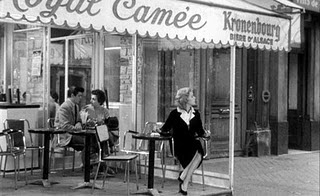
                   Parallel editing is used to show he is stuck in the lift, and Florence is looking for him. She fills the screen showing she is the man star of the film, low key lighting is shown here as it is at night; her face is lit only by the lights glowing inside the cafés and from the street lights. Because she has wrongly assumed Julien has abandoned her, the first notes from Davis's trumpet are sombre, echoing the heartbreak she feels as she searches for her lost lover. Tracking is used here, it was shot with a camera in a pram, and is the famous walk in real time and locations, no sets or rented cars; therefore shows the skill that is used by Louis Malle – An independent film producer.
                                                                           
This is the tracking shot where a camera was in a pram - It is now the most famous scene in 'Lift to the scaffold' and known worldwide.  
     Mary Sullivan                   
 

Tuesday, 15 February 2011

Questionnaire Results

From asking an equal amount of males to females mainly from the age range of 16-19, I have found out that most people like the suspense in thrillers but the genre of crime. This is usually because they like the reality of the story line which they can relate to. The main character and villain is the most important character within the film and that the majority of the group we asked watched thriller films every 3 months and like the characters best in thriller films. They equally liked male or female roles but not children and like films in colour rather than black and white as it is easier to watch and more enjoyable. The title is the most eye catching thing on a thriller film poster, which means our group needs to have a very good title to attract an audience. Thriller films are mainly watched by friends and should be opened by suspense. This shows that our beginning of the thriller could potentially contain suspense to draw the viewer in.

Focus group questions

1. What is it that you expect from a modern day thriller?
2. What’s your favourite Thriller and why?
3. What do you expect the protagonist to look like, are they male/female?
4. What do you expect the victim to look like?
5. What would you imagine both the protagonist and victim to wear?

6. What events/props do you expect from a normal thriller convention?
7. What is the type of location you expect to see in a Thriller?
8. What storyline do you expect from a Thriller e.g. Mystery?
9. What certificate do you expect a good Thriller to be?
10. What type of soundtrack what you expect?