Showing posts with label By: Mary Sullivan. Show all posts

Thursday, 5 May 2011

Evaluation question 1


1. The title.
The title of the film itself was called 'the existence'.  As a group, we decided to use this because it was an appropriate name for our thriller, giving the audience an idea of the genre of film (physiological thriller).  It also suggests abnormality, because 'existence' is not a word used commonly in everyday situations, and is often related to spiritual events or the dead, therefore foreshadowing our storyline.  The title also creates enigma as it allows the audience to ask themselves questions about what 'the existence' is, whether it means somebody or a spirit etc.  When researching what name would be best suited for our thriller, we completed some careful research and planning; through this we found name with only one word was most effective. Examples of this are: scream, & identity.  This is why we chose 'The existence', the word 'the' had to be put into the title, otherwise there is a risk it would not make sense and confuse the audience.

2. Setting/Location.
We used a variety of different settings and locations, as during the research process this is found to keep audience’s attention, and they were less likely to be distracted if there was more than one location.  The location on the mood board shows a narrow path, surrounded by woodland at each side, this is a normal road and path used, showing a normal thriller conventions as many thrillers events happen in everyday situations.  We chose this as it creates a feeling of isolation for the character.  The trees represent the pressure that is about to surround her when she can see hallucinations of a girl, the trees and narrow path also represent that she is trapped.  It also gives the audience an idea this is not her fault, and this is what is going to inevitably happen to her.  The second image on the mood board portrays this well, and although this is a normal thriller convention, it is used for a different purpose. 

3. Costume.
The costume for one of the main characters was an important introduction to our thriller, as it instantly showed the audience she was abnormal and the character can be seen fully in a negative light.  She appears several times throughout the film, also showing her abnormality as this is not consistent.  She is wearing a white dress which represents innocence, however it has severe blood stains down it with mud and grass stains as well.  This shows the audience her innocence has changed now, also shown by the pale face and black makeup running down her face.  We decided for her to wear this item of clothing, as it creates enigma for the audience whilst allowing the film to develop exploiting this character.  This goes against the normal conventions of a thriller, as it is typically seen that the protagonist would be male, it is unlikely there is both a protagonist female and an antagonist female.  This could appeal to a wider demographic for our thriller, as it creates an unusual situation which is not typical of this type of film.

4. Camera work.
This image shows a long shot of Tabi walking; this image is successful because we decided to film at a particular time when the sun was setting.  Therefore, this allowed the sun to be shining through the trees where Tabi was walking, the difference between light and dark represents her mental unstableness, that she has two sides to her personality and is in fact schizophrenic.  This is also represented by her costume as she is wearing dark trousers with a white top.   We chose to use a long shot as it shows how she is coping on her own, exploiting her unstable-ness as she falls down during the scene and has extreme hallucinations’ when normal everyday life is going on around her (the public is seen in the background).  This goes against the conventions of a thriller, as alot of thrillers use low key lighting to set a dark mood, however here we have used a selection of lighting making our thriller different from the others. 

5. Title font and style.
The title font and style challenge typical thriller conventions because the majority of thriller films have spaced out writing that is clear and easy to read.  Our thriller goes against these conventions, with the writing being close together, without large spaces and is not easy to read.  This suggests our thriller will not be foreseeable, and this is what we aim to achieve.  We have also used the connotations of black on white to represent life and death, as our main character is struggling in the middle of both of these extremes with her mental illness.  The font we used fits in well with our thriller, and is consistent throughout each individual title font during the beginning of the film.

6.  Story.
The typical storyline for thrillers are dependent on their genre.  In physiological thrillers, it often involves illusions, crimes committed due to a poor mental state or the main character searching for somebody.  In our film, we have illusions, as our main character can see things that are not there.  However, this is not shown in the typical stage of events within our film, as this is introduced straight away suggesting there may be more events taking place when the film continues.  Although we are following the same ideas in our thriller, the way they are laid out is different showing we have been original within completing our work. From having an enigma the whole way through it builds tension for the audience as they do not know who Alex is as it is never explained.

7. Props.
This scene contains certain props, we have used extreme make up and fake blood to create a sense of instability amongst one character, however the most important prop used was the mirror.  This was used to show when the abnormal girl was there, and when she wasn't, this helped make a clear distinction between was real and what wasn't.  The over the shoulder shot in picture 7, show the main characters mind playing tricks on her, with all the hallucinations which are taking place.  If this prop was not used, it would have been significantly difficult to get this message across to the audience, and was extremely important when filming.  This prop is a typical convention of a thriller, and is often used in physiological thriller for the same purpose.  However, an over the shoulder shot against a mirror is unusual, as the series of abnormal events usually take place in the mirrors reflection within thrillers.  An example of this is the film 'mirrors'.

8. Genre.
The genre of our film is shown by the disturbed girl, the way she watches the main character (Tabi) suggests she could be a stalker, a hallucination or somebody who has died.  All of these ideas have a link with mental illness that the audience may have already noticed.  The theme of mental illness links in with our film well, as our genre is a physiological film, with our main character suffering from schizophrenia.  This is also clearly shown as the public are in the background haven't appeared to have seen this girl, showing she is abnormal.  This sets the tone of our film and represents what it is ultimately going to be about, this goes against the normal conventions of a thriller as it is unusual to see the characters together at the beginning of a film.  Usually, one character develops from a series of events, or something that has been triggered such as a past memory in physiological films.  An example of this happening is in 'mirrors' or 'inception'.

9. Characters.
The two main characters are show in picture 9; the pictures are put next to each other to show the differences between the characters appearances.  They are shown in a serious way, as what happens in our film is not based around crime, but about mental disability.  The shot of our main character (abnormal girl) standing over our other main character at the beginning of the film shows proximity between them and suggests they will have some type of relationship later on or already within the film.  This goes against the normal conventions of a thriller, as usually the characters are gradually introduced as the story develops, however in this beginning scene they have close proximity to each other.  This creates enigma for the audience, as questions build in their mind of how they could possibly know each other, and why one is standing over the other one sleeping - this is distinctly abnormal.  The audience don't know whether the person sleeping (Tabi) knows she is being watched or not therefore raising more questions between the characters, intriguing the audience to watch the rest of the film.

Monday, 7 March 2011

Costumes and Make-up

Tabi, (The Antagonist) her make-up will be like a normal teenager girl’s style make-up. She will have mascara on, foundation, bronzer and lip gloss. We will buy the mascara and it will be cheap as we have a small budget, however this is also good because when we do a crying scene the mascara will run easily showing black tears create the desired effect for the audience to feel intimate with the antagonist, whilst not wasting anyone’s own products.  The emotions used will also keep up the audiences expectations of the film, creating enigma for the audience.  Her costume will be black jeans and she will have a white top on that will flow this will suggest to the audience that she is innocent. 
This will also show a deep contrast with the black jeans against the white top which is representing her split personality as she is schizophrenic.  She will have military boots on, so when she is running the boots will suggest to the audience that she is fighting for her survival and is a strong character.  She will have a khaki coat on that will be quiet big so she can, sort of, hide in it to show her vulnerability.  Georgia, (The Protagonist) will be wearing/edited white contact lenses to show she is abnormal, she will have straight, hair sprayed hair in a middle parting. Her make-up, she will have black eye make-up and her skin will be pale white, representing her abnormality. 
She will wear a white dress to show her apparent innocence, this will create enigma for the audience as they will be unaware of who this girl is at this certain time.  The young girl will wear a white dress that will be dirty to show that she was innocent but a series of events has changed this.  She will also wear a hospital wristband to show that she was close to death.  Also, because the camera will have a close up on her face and makeup it will be clear to the audience that she is abnormal.   
                                 -By Rachel Wardley, Mary Sullivan, Charlotte Mackenzie and Alex Fresco

Monday, 21 February 2011

Background Research & how lift to the scaffold (1958) was developed.

Thrillers began and started in the 1900's where cinemas were developed. Large companies like Warner & Sony took over the market share of the film industry, as they began to produce a large quantity of films one after another. This process was continuous with famous actors signed and contracted to these big labels, and often appeared regularly; therefore once a film was released they would start filming for the next film. 
Although each company has developed since the 1900's, with Warner and Sony both expanding and differentiating into different markets, the main difference is that back in the 1900's each company produced a different type of film. Also, the films were rolled out continuously. 
          However, not everyone agreed with this concept, in the 1900's there were some objections with this 'fast film' process. Two French writers decided to produce their own films and this was the first film not produced by a company that dominated the film industry but by two amateur individuals; with a lack of experience and funds. Louis Malle, 25 was directing the film 'lift to the scaffold', first known as ascenseur pour l'echafaud (known as 'elevator to the gallows' in the U.S).  This film was produced in 1958. 
Louis Malle didn't want films to be churned out like a factory, as his ambition was to be not only the director but the author of the film; putting more time and consideration into it. He didn't want this film to be another mass produced studio film, because of this 'lift to the scaffold' became a landmark film, changing the film industry since it first existed.
Louis Malle had an inspiration; this was 'Alfred Hitchcock' and kept the spirit of the film. This meant it was the directors vision and not mass produced 'Physco' being the most popular film.   This was, undoubtebly, Louis Malle's biggest influence & the reason Louis Malle looked up to Alfred Hitchcock was because he wanted 100% control of his own film.   'Lift to the scaffold' was a landmark film, it was a clever thriller, made in basic conditions. This holds a certain appeal to the audience and is an indication of what could come next from the film industry; this film introduced a French 'New Wave'. It made Jeanne Moreau an international star due to this influential film. The film itself used real life locations as sets would be too expensive. The film starts with a close up; this identifies the character showing her importance, whilst making the audience feel intimate with her, because she is crying. This also displays a vulnerable character, showing a weakness as she is also wearing no make-up, something which is often a girls' priority. 
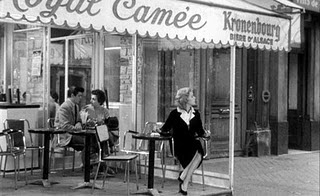
             The credits are white because it was a black and white film, a conventionally motivated opening with Jeanne Moreau's tearful fast whispering ''Je t'aime'' - showing intimacy.  Here, the camera pulls back to reveal her (Florence) is alone, speaking into a telephone.  The audience did not expect this; it is the first of many technological surprises used in this film.  Enigma is used a lot here; this is where unanswered questions are created for the audience to get them thinking when the film begins. Whispering on the telephone call suggests something is wrong, whilst credit come on screen against the persons face; this shows the style of the film.  The audience see an establishing shot in reverse as the camera draws back till the audience see her side-on in a public telephone box. Her crime is suddenly set in the real world.  Then cuts to a matching shot to a man on the other end of the line - her lover, who responds, “Without your voice, I’d be lost in a world of silence.” As the credits come up and Davis’ – trumpet enters for the first time, music by Miles Davis a jazz trumpeter. 
The music is unpractised and improvised as a lot of jazz music is, this had a big influence on thrillers when a mood was being created.  Each lover is shot through frames – her in a phone booth, him through the window of an office buildings – this portrays to the audience they are kept under surveillance, a strategy that anticipates the introduction of a crime.  This is also an establishing shot in reverse as the camera draws back to show the office location, reactions shots are used which modern generations of films lack as they are used to fast paced moving films.  The camera, stays on the reaction shot so the audience feel connected with the film, whilst accentuated sound tells the audience something important is going to happen, building suspense whilst showing time passing by. This is shown by footsteps, and when the man is in the office a perfect long shot is used to show who is dominant and holds power.   
 This is ironic, because the man holding power gets shot. Because of this and the conventional props used such as a rope and a gun, whilst also using elements iconic to thrillers such as a beautiful women, 'femme fatale' = fatal women, getting the man to commit her crime. This film can also be portrayed as a crime thriller as it has elements within it. There are also strange devices used, with rope and gloves to catch the audiences interests, a shot reverse shot is used in the office for enigma as it gets the audience to think 'will he change his mind' however the low angle of the killer shows the fatality that will happen next. 
                    Parallel editing and accentuated sound of the women and the pencil sharpener hide the sound of the killing, as it is made to look like a suicide. However, the rope is left showing the damaging events that took place; there is a close up of the expensive car, something that is iconic in thrillers. Also, the equilibrium has changed now, because life in the film was normal until the disequilibrium (murder) and now there are complications (caretaker cuts off lift when the man realises he left the rope up there and goes back). Thrillers often use entrapment, which are small confined spaces such as the lift. Now Jeanne (Florence) has not heard what has happen, she is alone in the romantic city of Paris – showing her vulnerability. Audience are asking themselves questions of what has happened, whilst the car goes past not driven by him – creating more questions, a strong enigma. 
                   Parallel editing is used to show he is stuck in the lift, and Florence is looking for him. She fills the screen showing she is the man star of the film, low key lighting is shown here as it is at night; her face is lit only by the lights glowing inside the cafés and from the street lights. Because she has wrongly assumed Julien has abandoned her, the first notes from Davis's trumpet are sombre, echoing the heartbreak she feels as she searches for her lost lover. Tracking is used here, it was shot with a camera in a pram, and is the famous walk in real time and locations, no sets or rented cars; therefore shows the skill that is used by Louis Malle – An independent film producer.
                                                                           
This is the tracking shot where a camera was in a pram - It is now the most famous scene in 'Lift to the scaffold' and known worldwide.  
     Mary Sullivan                   
 

Sunday, 13 February 2011

Preliminary task, storyboard.


Wednesday, 2 February 2011

Possible Location

Here is a possible location where we may film our thriller; it linked well with our initial ideas for a thriller however it is a convention of a thriller film.  Our group may go against the conventions of a thriller, or create a unique difference to our convention location, therefore this is still only a possibility.
Option 1.


Monday, 31 January 2011

Preliminary work.

For our preliminary task, we were asked to film a short clip.  In our group, we discussed the different shots we could use, and then concluded on the shots we were going to use, in mutual agreement.  Together, we designed and created a storyboard providing a visual image with detailing at the side to show how we would complete our preliminary task, this also showed the audience what shots we were using at different times.  This helped our group learn what to do when we came to film our thriller, and allowed us to adjust to using a camera, it also helped us adjust more to working in a group effectively; everyone's views, ideas and opinions were taken into consideration.  This was positive and we have set a time on how long it will take us to film our preliminary work, so it does not disrupt our thriller filming.  Luckily, because of a detailed storyboard the preliminary filming was not difficult to do, as we already decided on our location, camera shots, mise en scene, sound and editing.
These were basic so the task would not be time consuming, however completed well.  My group also considered the 180 degree rule, this is where the camera does not go past 180 degrees, otherwise the filming will not make sense as the people involved, would have changed sides; consequently confusing the audience.  Therefore, our group strongly tried to avoid doing this, an example is below.

Friday, 28 January 2011

Initial ideas - type of thriller we chose

When looking at the different genres of thriller conventions, as a group we came up with a short-list of thriller conventions that interested us and we may be able to use for our final thriller filming. Here are some mood boards showing images relating to each conventions and our final decision explaining why some of these were not suitable.
Medical/disaster thriller
A medical/disaster thriller is where the hero or heroine are medical doctors working to solve an expanding medical problem, such as 'Awake'. A disaster thriller in which the main conflict is due to a natural or artificial disaster such as floods, earthquakes, etc with an example being 2012. We considered these genres as a group and discussed them in detail; we all agreed a medical thriller is a good idea, where the story line could be adapted easily. However, it would be difficult to incorporate the background into a medical thriller for example a hospital, as permission to film would be unlikely. Also, after watching the beginning of some medical thrillers we realised we did not have the available equipment to create realistic wounds. However, as a group we all liked this idea, and did eventually incorporate it into our final film, exploiting mental problems.
Crime thriller A crime thriller is a genre that offered crime films and thrillers linking together, it shows a suspenseful account of a successful or failed crime and the implications it has had. It often has focus on the criminal, showing his/her lifestyle and weapons they may use within their crimes. Also, it often shows police in a negative light, an example of a crime thriller is 'Seven'. As a group, we decided not to use a crime thriller, as it would be difficult to shoot with the stereotypical setting being based around a police station or bank, and we did not want to alarm any members of the public by the props we would have used (guns, knives) even if they looked unrealistic. It would also be difficult to include our ideas of mental illness within a crime thriller.
Legal/political thriller
A legal thriller shows lawyers to be perceived in either a positive or negative light, confronting enemies outside and inside the courtroom. It usually perceives lawyers to lose a case or their life, and has a lot more based around a case than just the outcome, such as disturbed gangs etc. An example of a legal thriller is 'A few good men'. As a group, we all quickly came to the conclusion that using a legal thriller would not be suitable for us with the information needed and equipment we had available. We also considered whether a legal thriller would appeal to a mass market surrounding our targeted age group, and decided it wouldn't appeal to everyone. Therefore we decided not to include any aspects of a legal thriller within our film.  This could also link to a political thriller such as 'The constant Gardener' where the hero/heroine must ensure the stability of the government, we also decided this would be too difficult to include.
Psychological thriller
A psychological thriller often shows the main character suffers from mental and emotional pain, rather than physical pain an example of this is 'Psycho'. As a group, we all quickly decided this would be an effective genre to use within our thriller film as our main theme. This will shock and disturb the audience, whilst creating a unique and unusual circumstance so it is not a typical storyline, for example murder. Here, we carefully began to plan our how we could adapt a psychological thriller to meet our demands with the equipment available, we looked at all different sections to do with a psychological film and decided a split personality disorder or schizophrenia would be the most effective if we could successful demonstrate this within our film to our audience. Therefore, lots of planning and research was necessary to make sure we understood these disorders, and eventually we picked schizophrenia as our main character can see a girl who is not really there.

initial ideas

Initial ideas for our thriller film.
Here, in our group we discussed possible ideas we could use when filming and factors which would affect whether they would become successful or not.


Location
  • wood location
  • empty or abandoned house
  • ally way
  • empty train station, or public place
  • quiet road / empty lane
  • hospital
  • flats
However, we had problems with each location and therefore had to discuss whether they would be suitable.  The problem with: the woods, it was stereotypical convention of a horror film and had been done before.  A house would be hard to find empty unless someone was moving, and permission would be hard to get granted from someone we don't know, it is also a convention of a horror film.  The audience expect the scene to be an ally way, therefore it will be less shocking and could affect them more if it was filmed in a public place.  However, it may be difficult to use a public place with props such as knifes which could cause the general public to report our group; the same problem occurs with the flats.  A quiet road would be suitable, however it may only be quiet at night, and permission may not be granted for a hospital, or its surroundings.


Sound
  • Changes if there is a flashback
  • Edgy, building up suspense at key points during the film
  • Violins could also be used to create a strong effect on the audience
  • A music sting, when there is a change of scene that shows importance
  • Changes between diegetic and non-diegetic sound
Camera angles


  • A variety of shots used to show skill, however we initially decided to use:
  • Long shot
  • Mid shot
  • Close up                                                         
  • Extreme close up
  • Point of view
  • Over the shoulder shot
Mise en scene
  • Every day clothing for the victim, this makes it seem more realistic and relates it to the audience
  • 'Odd' clothing for the killer, unusual
  • Realistic props if any
  • Realistic 'blood' makeup, if needed                              
Editing
  • Parallel
  • Continuity
  • Rapid
Flashbacks, someone waking up from a nightmare - looking up to see that its real, night time and the use of a isolated place were all popular ideas when discussing.  However, these might change as the horror is adapted to suit the requirements of the film, whether there is suitable permission to film within an area, and to make sure our film goes ahead without concerning the general public.

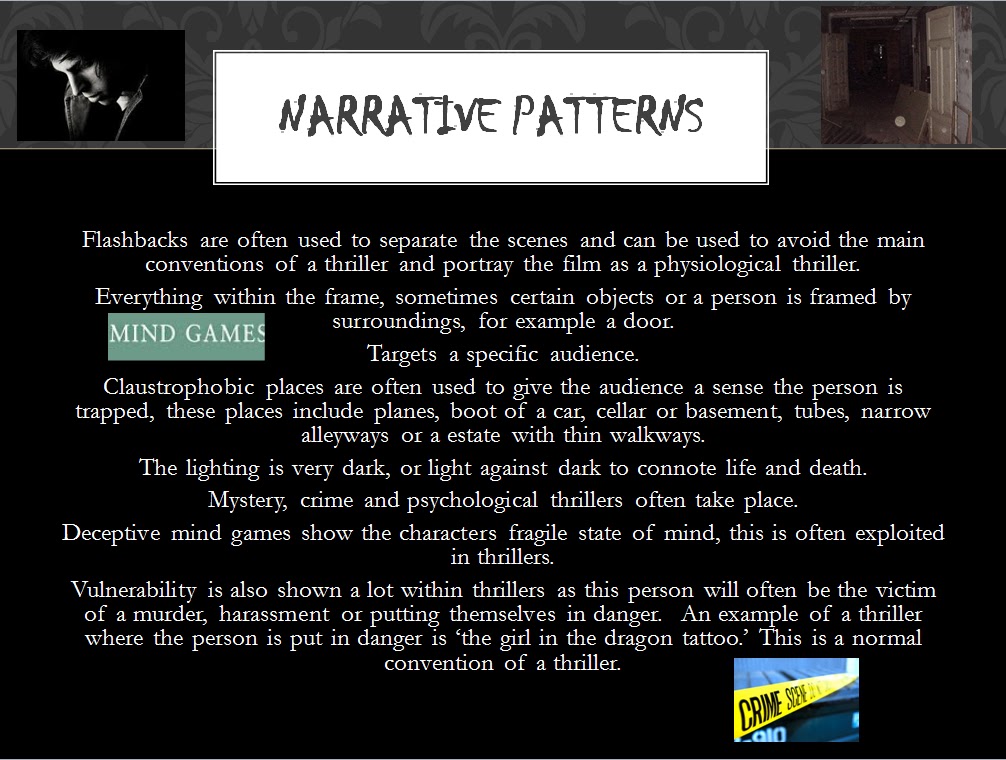
Codes and conventions of a thriller


Guide to follow when completing coursework, early planning.

Coursework dos and don’ts.
Do…
·        Plan the coursework in detail, writing down all ideas and some of these can be incorporated into the final filming.  Each stage needs to be detailed with a suitable location so you have an area/idea to film around.
·        Write down different camera shots and editing (for example rapid editing) you want to use within the filming then the group can try and think of different ways to incorporate this.
·        Decide on the main story then make different adaptions to it.
·        Go out and find all the props and costumes needed, as this may be time consuming if they are hard to get hold of.
·        Give each person in the group a set job to do as long as they are happy with their job, therefore nobody is wasting time.
·        Organise a meeting and allocate something to do each lesson, also when to meet outside of school or in frees to sort out any details of the coursework.
·        Give certain deadlines of when to get areas of filming done and edited by.
·        Other aspects could also be incorporated such as flashbacks and low key lighting/shadows to create a negative effect.  This could also be shown by editing and the weather.
·        Also, the group should organise to get each other’s contact numbers so everyone knows if something has changed, and everybody is kept up to date.
·        Make sure everything is updated onto the blog, and any changes are written or uploaded on here using proper English, no ‘slang’ therefore it is easy for the examiner to understand.
·        Listen to everyone’s ideas, or if there is a problem when filming or someone has come across a problem take note of it as it could be edited or improved. 
Don’t…
·        Choose music that is not relevant to a thriller film, an example of this is upbeat & happy music.
·        Choose music that is copyrighted, you can’t use it.
·        Create the beginning of a film which is not in the horror genre, you will not get a good grade.
·        Too much editing; your coursework won’t make sense as you have missed out complete scenes.
·        Wait till the last minute to start your coursework, you won’t have enough time to fully complete it and this will lead to rushing it. Certain aspects won’t get finished properly such as editing.
·        Not do the work, you are marked individually therefore if you haven’t done anything you won’t get a grade.
·         Don’t wear costumes that aren’t relevant.
·        Don’t use props that aren’t realistic, an example of this is a water gun.
·        Don’t argue with your group – you can’t change groups once the coursework is started.
·        Don’t leave work incomplete to ‘do it later’ because it will be left and won’t get done.
·        Don’t forget about the blog, this is an important aspect about the coursework and if you forget this it will lose you a lot of marks.
·        The blog needs to be updated regularly in order to get a good grade, if you leave the blog till the last minute it does not show the stages through the filming process and the choices your group had used, therefore it seems unorganised and rushed, losing your group a lot of marks.
·        Don’t stick to one item of technology to upload things to the blog; you can also use video cameras to record discussions to gain you higher marks.